
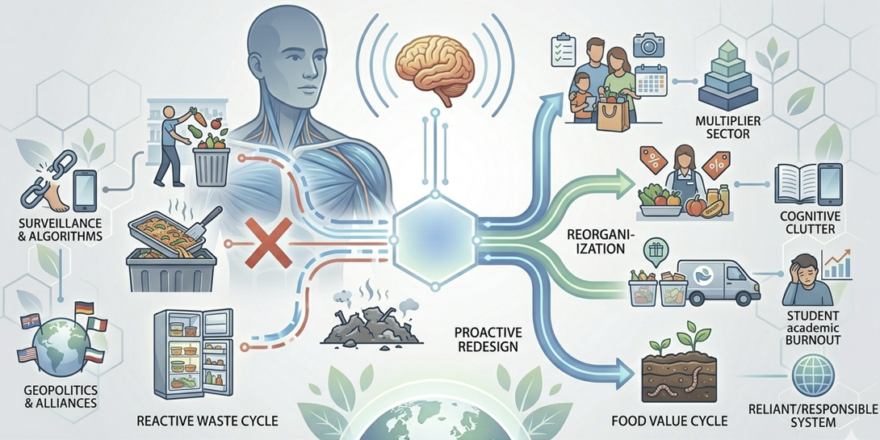
The Hidden Cost of the Uneaten: Why Food Waste is a Silent Crisis
The Hidden Cost of the Uneaten: Why Food Waste is a Silent Crisis
When we imagine “living sustainably,” our minds usually jump to high-tech solar arrays or the sleek lines of an electric car. We rarely think about the bruised apple at the bottom of the crisper drawer or the leftovers we forgot in the back of the fridge. Yet, food waste has quietly become one of the most pressing environmental challenges of our time. It isn’t just a matter of “bad habits”; it is a systemic failure that bleeds resources from our planet, our economy, and our communities. Every time we scrape a plate into the trash, we aren’t just discarding calories—we are discarding the entire life-support system that brought that meal to our table.
To understand why this is such a heavy burden, we have to look at the “hidden” ingredients in every bite. Producing food is an incredibly resource-intensive process. It requires thousands of gallons of water, vast stretches of fertile land, back-breaking labor, and massive amounts of fuel for transport. When a loaf of bread is thrown away, we are essentially throwing away the irrigation used on the wheat fields and the diesel used by the delivery truck. In a world with finite resources, treating food as disposable is like leaving a faucet running or keeping the lights on in an empty house. It is a waste of the very systems that keep us alive.
The environmental toll goes even deeper when that food hits the landfill. Unlike organic matter that decomposes naturally in a forest, food buried under mountains of trash lacks the oxygen it needs to break down cleanly. Instead, it roasts and releases methane, a greenhouse gas significantly more potent than carbon dioxide. This creates a double-hit for the climate: we emit carbon to grow and ship the food, and then we emit methane when we throw it away. If food waste were a country, it would be the third-largest emitter of greenhouse gases in the world, trailing only the United States and China.
Beyond the numbers, there is a profound human imbalance at play. We live in a world where millions of people go to bed hungry every night, yet we discard nearly a third of all food produced globally. This isn’t just an “efficiency” problem; it’s an ethical one. Our modern systems are often designed to value aesthetic perfection over nutrition. Supermarkets reject “ugly” carrots, and restaurants over-prepare to ensure a full menu, while families buy in bulk to save money only to lose half the haul to spoilage. We have learned to fear expiration dates that are often just suggestions of peak quality, not warnings of safety.
The good news is that solving food waste doesn’t require a scientific miracle; it requires a cultural shift in how we value what we eat. It starts with simple, human actions: planning a grocery list, embracing the “imperfect” produce at the market, and learning to love leftovers. On a larger scale, it means businesses donating unsold goods to shelters and governments investing in composting rather than landfills. Sustainability isn’t just about creating new, “green” things—it’s about respecting the things we already have. By treating food as the precious resource it is, we begin to build a future that is not just more efficient, but more just and resilient for everyone.
HAODE (YUKI) CHEN