
Tourism and the Asia-Pacific Uneven Recovery Economy
Tourism and the Asia-Pacific Uneven Recovery Economy
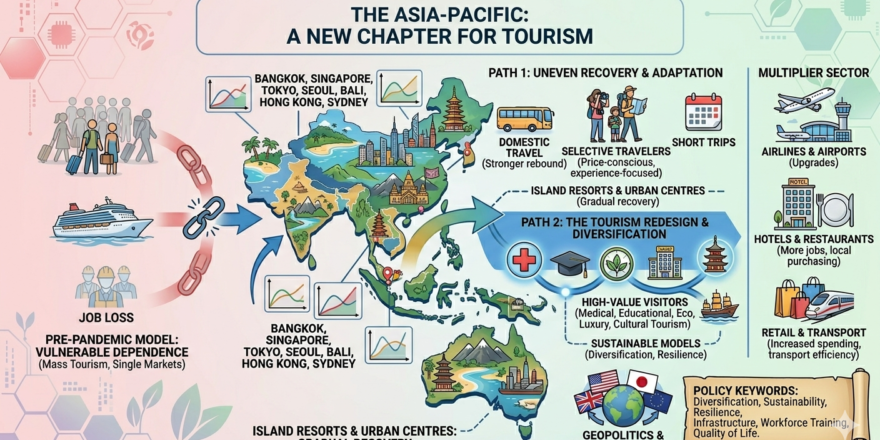
Tourism has remained as one of the most significant economic drivers in Asia-Pacific region. The pre-pandemic cities of Bangkok, Singapore, Tokyo, Seoul, Bali, Hong Kong and Sydney are tourist destinations that accommodated millions of travelers annually before the pandemic, contributing to airline, hotel, restaurant, retail, transport, and cultural sectors. Tourism was not merely a periphery to the economy of many economies in the region. It was a significant job creator, source of foreign exchange and small business. The most interesting thing about the current period is that there is the recovery in tourism, although uneven. The very act of recovery is redefining economic priorities in the Asia-Pacific.
Timing is one of the largest discrepancies of the post-pandemic tourism economy. Certain destinations have opened sooner and have bounced back in a better manner whilst others experienced a slower recovery because of tougher boundary measures, slower flight recovery, or less consumer demand. Consequently, there has been an unequal distribution of the benefits of returning tourism. The economies relying on a large influx of international tourists, particularly island resorts and urban centres of service-based tourism, have been forced to recover gradually. In the meantime, destinations with robust domestic tourism markets usually bounced back faster since they could count on the in-country traffic until foreigners returned in large numbers.
This lopsided recuperation is noteworthy since tourism contributes to a comprehensive set of economic endeavors. An influence reaches much further than the airline when the tourist orders the flight. Airports are paid, hotels employ workers, restaurants buy more food, transportation providers in the country get more clients and shopping areas receive more consumers. Tourism in this way is a multiplier sector. Its revival will aid in curbing unemployment, which will identify city centers and foreign currency earnings. In the case of countries enduring the pressure of trade or sluggish export growth, tourism can act as a significant cushion to the economy.
The other significant trend is that tourists are differing in terms of spending. Modern day travelers are now more discerning, price-conscious and experience more than ever before. They are more in demand to make shorter trips, flexible bookings, nature-based travel, and destination that is perceived to be safe and convenient. This is motivating the governments and businesses in the region to re-strategize their tourism strategies. Most of them are not just following the number of visitors but are aiming to acquire higher revenue earners who take their time at their destination and spend. This may imply encouraging medical tourism, educational tourism, eco tourism, luxury hospitality tourism or culture tourism instead of simply depending on mass tourism.
The recovery also has depicted structural weaknesses. Most of the economies that are reliant on tourism found that they were highly susceptible to the unexpected external shocks. To work down during the low travel years, millions of workers lost their jobs, small businesses collapsed, and local communities lost income. Welcome back tourism and policymakers are raising questions on whether the old model was too narrow. This has resulted in the discussion on diversification, sustainability, and resilience. When a destination is over-reliant upon a single market, a single route network or even a single kind of traveler, it becomes economically vulnerable.
Meanwhile, the tourism of Asia-Pacific is getting more competitive. To kickstart tourists revisiting their countries, countries are providing a visa-free entry, digital nomad programs, upgrades to their airports, and marketing efforts. More than promotion, though, will be the key to long-term success. It will be conditional on the level of infrastructure development, transportation efficiency, environmental protection, training of the working population and the capacity to manage a balance between growth and the quality of life in the region.
Asia-Pacific is no longer all about recovery in tourism. It is concerning redesigning. The economies of the region are discovering that travel can give growth in a rapid manner, however, sustainable growth needs more intelligent planning, more robust systems, and more resilient of a model, as compared to what previously existed and was in place.
GUOYANG (GARY) ZHENG