
The Social Penalty for Not Drinking
The Social Penalty for Not Drinking
In many cultures, drinking is treated as a normal part of adult life. It is built into celebrations, networking events, first dates, office parties, college social life, and even casual dinner plans. Because alcohol is so socially accepted, people often assume that choosing not to drink is a small and uncomplicated decision. In reality, for many people, it carries a social cost. Refusing alcohol can lead to awkward questions, exclusion, suspicion, or pressure to explain something deeply personal. That makes sobriety—or even occasional abstinence—not just a private choice, but a social issue.
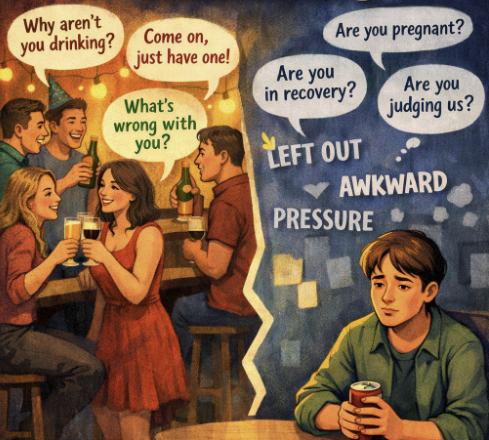
The pressure often begins with language. Someone who says “I’m not drinking tonight” is rarely left with that answer standing on its own. Instead, they may be asked why, whether they are sick, pregnant, “boring,” or secretly judging everyone else. What should be a neutral boundary turns into a performance of justification. The assumption behind these reactions is that drinking is the default, and not drinking is a deviation that must be explained. That norm can make social spaces feel hostile to people in recovery, those with health conditions, religious commitments, medication conflicts, or simply different preferences.
This issue is especially visible among young adults. In many school and workplace environments, alcohol functions as a shortcut to belonging. To drink is to seem relaxed, fun, sociable, and easygoing. To abstain is sometimes read as stiff, antisocial, or overly serious. That divide affects who gets invited, who feels comfortable showing up, and who gets left out of informal bonding opportunities. Some people do not want alcohol itself nearly as much as they want the acceptance that seems to come with participating.
The consequences can be more serious than awkwardness. For someone trying to maintain sobriety, repeated social pressure can become emotionally exhausting or even dangerous. For people who have experienced addiction in their families, or who are struggling privately with their own relationship to alcohol, the expectation to “just have one” ignores the complexity of what is at stake. Even for casual non-drinkers, the constant need to manage other people’s reactions sends a broader message: your boundaries are less important than the comfort of the group.
This is part of a larger social pattern in which conformity is rewarded more than self-awareness. A person who knows their limits and sticks to them should be seen as responsible, not difficult. But many social settings are still built around the idea that participation must look the same for everyone. That creates environments where personal autonomy is quietly undermined in the name of fun, bonding, or tradition.
A healthier culture would normalize choice without interrogation. Hosts could offer nonalcoholic options that feel intentional rather than like an afterthought. Friends could stop treating abstinence as a problem to solve. Workplaces and campuses could build social events where alcohol is not the center of connection. Most importantly, people could learn to hear “no thanks” as a complete sentence.
The social penalty for not drinking reveals how easily a personal boundary can become a public test of belonging. A more respectful society would not measure openness, adulthood, or likability by what is in someone’s glass.