
Asia-Pacific New Supply Chain Geography
Asia-Pacific New Supply Chain Geography
The Asia-Pacific region is witnessing a new economic era which this time is not just characterized by growth, but also reorganization. The history of the region was economic in nature, and it was constructed around a single pattern over the decades; manufacturing in China that is being anchored by the shipping routes, supplier networks and export demand in the United States and Europe. Those model did not disappear, but it is evolving. As the Asia-Pacific region is changing its supply chains today, companies have to adapt to increasing labor expenses, geopolitical tension, technological change, and lessons of the pandemic. The outcome is a more diffused and strategically significant regional economy.
The emergence of the strategy of China plus one is one of the most important developments. Many multinational firms are not abandoning china but are retaining a section of their production to it as they expand into new countries like Vietnam, India, Indonesia, Thailand and Malaysia. Such nations have various favorable conditions. Vietnam has been made to be appealing in terms of assembling electronics and apparel. India is attracting concern due to its huge labor force and domestic market. Indonesia is becoming a significant source of supply chains of electric vehicles due to the presence of nickel resources, and Malaysia in the sphere of semiconductors and high-value manufacturing.
This change is bringing in competition and opportunity in the region. To attract foreign direct investment, governments are scrambling to enhance the ports, industrial parks, customs regimes, and training of their workforce. Low costs will not always ensure success, in many instances, but reliability. Companies are very concerned over whether a particular country is able to deliver consistent power, efficient logistics, reliability of regulation as well as skilled labor. This has led to infrastructure and governance being key constituents of economic competitiveness.
The semiconductor industry is another significant influence on the region. Chips have been taken to the heart of the world economic and strategy competition, and the Asia-Pacific is the leader in projecting, manufacturing, packing and testing of chips. Taiwan, South Korea, Japan, Malaysia and Singapore play very crucial roles in this ecosystem. Due to the power conversion to semiconductors of various devices such as smartphones, cars, and defense systems, countries are offering them not just as marketed products, but as strategic assets. This has contributed to increased social investment, industrial policy and coordination of regionally.
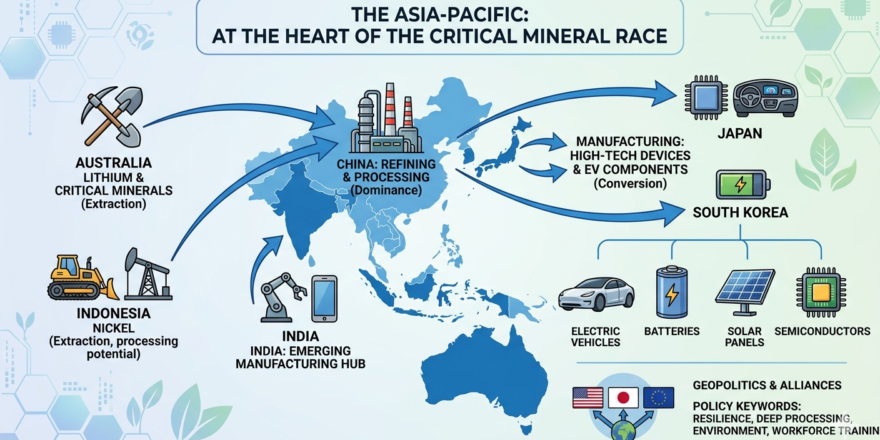
Meanwhile, new economic opportunities are emerging as a result of the energy transition. Electric vehicles, batteries, solar panels, and critical minerals are being in demand within the Asia-Pacific. Australia is a major supplier of important raw materials, China is a manufacturing powerhouse in the field of green technology, and the southeast countries are attempting to ascend the value ladder. The major question in the minds of many of these economies is whether they should stop being mere exporters of raw materials, but rather become processors, manufacturers and technologically endowed.
Nevertheless, there are severe problems in the region. The development is disproportional, the inequality is not going away and the vulnerability of smaller economies to external shocks is indeed a weakness. There is also climate risk which poses a menace to the infrastructure, agriculture and coastal trade hubs. The region will also need to reconcile the economic and strategic integration. Nations desire trade, investment and innovation, but they also desire stability and independence in a more shaky than ever before world.
The Asia-Pacific economy is no longer merely a tale of fast-growing economics. It is an adaptation tale. Those countries which are successful will be those ones which will be able to create robust supply chains, invest in people and technologies, and will be able to convert global uncertainty into local strength.
GUOYANG (GARY) ZHENG